
‘Responsible Statecraft’, a publication of analysis, opinion, and news that seeks to promote a positive vision of U.S. foreign policy based on humility, diplomatic engagement, and military restraint, asked some experts to gauge the short and long term effects of Kyiv’s bold invasion on the war.
‘Responsible Statecraft’: What does Ukraine’s incursion into Russia really mean?
Tag: World War II
Reading Update 08-10-2024: Mao Zedong vs Elbridge Colby

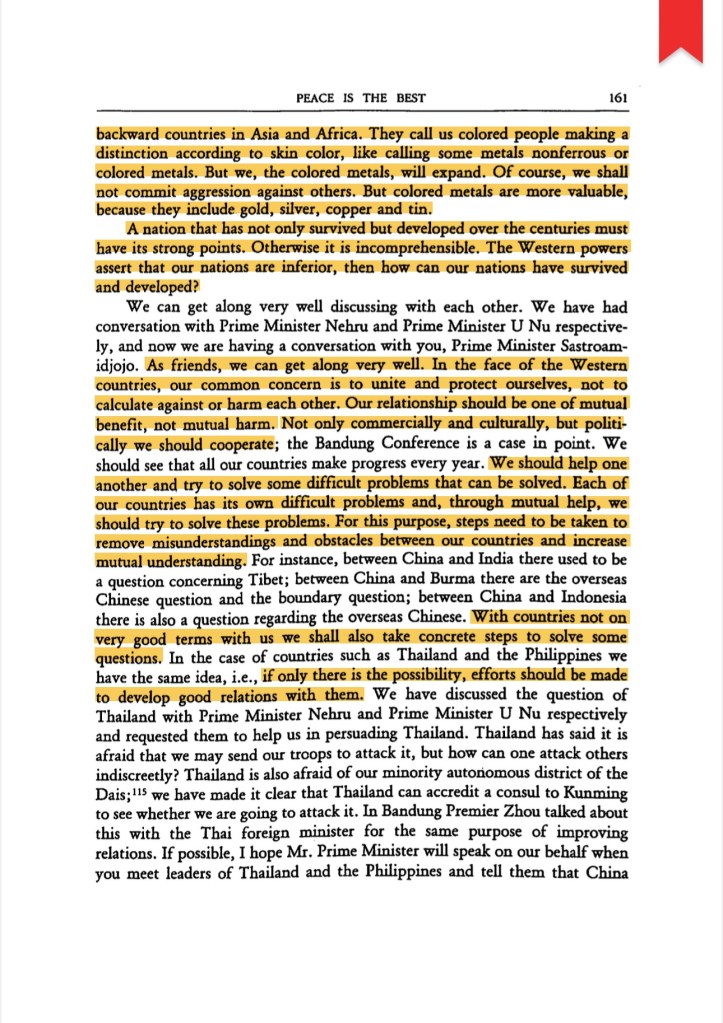
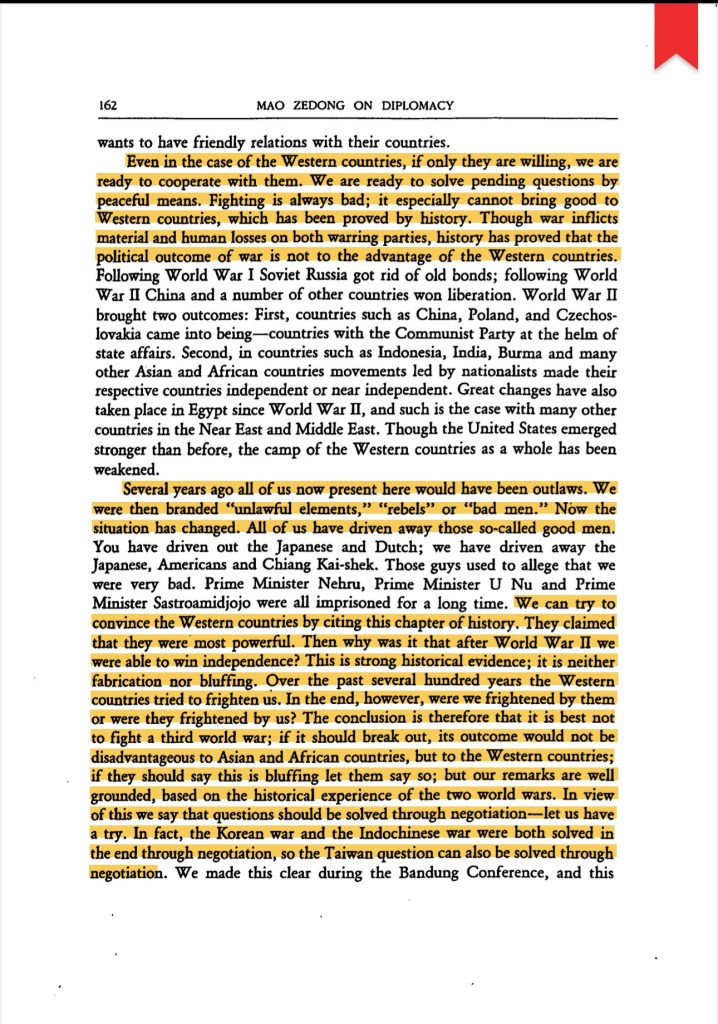

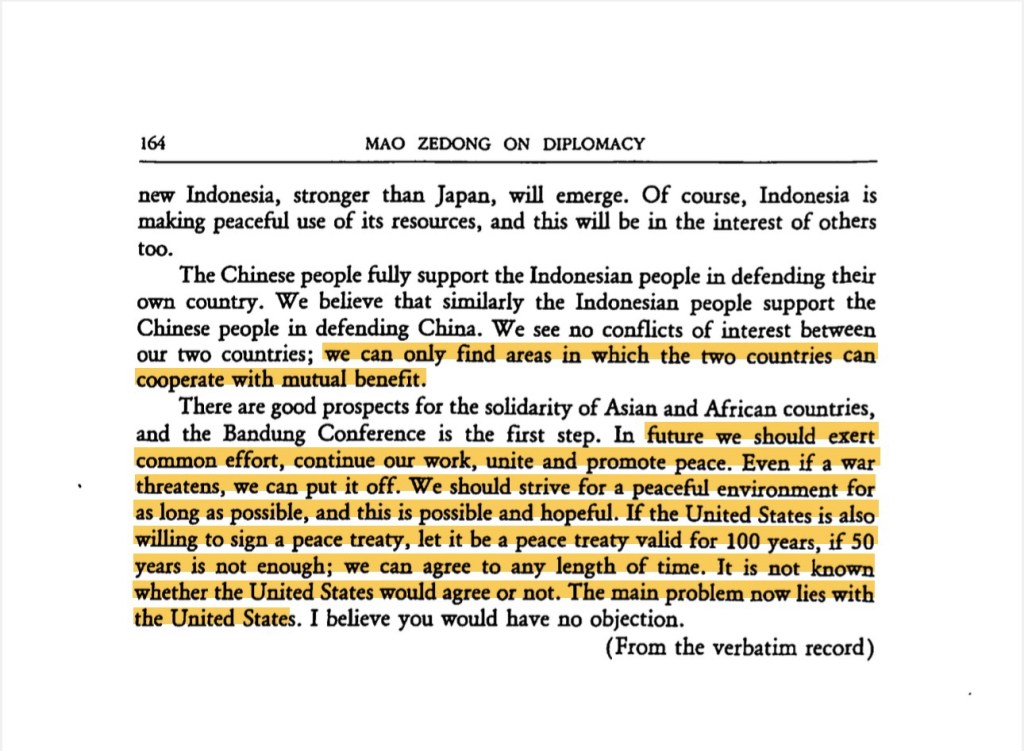
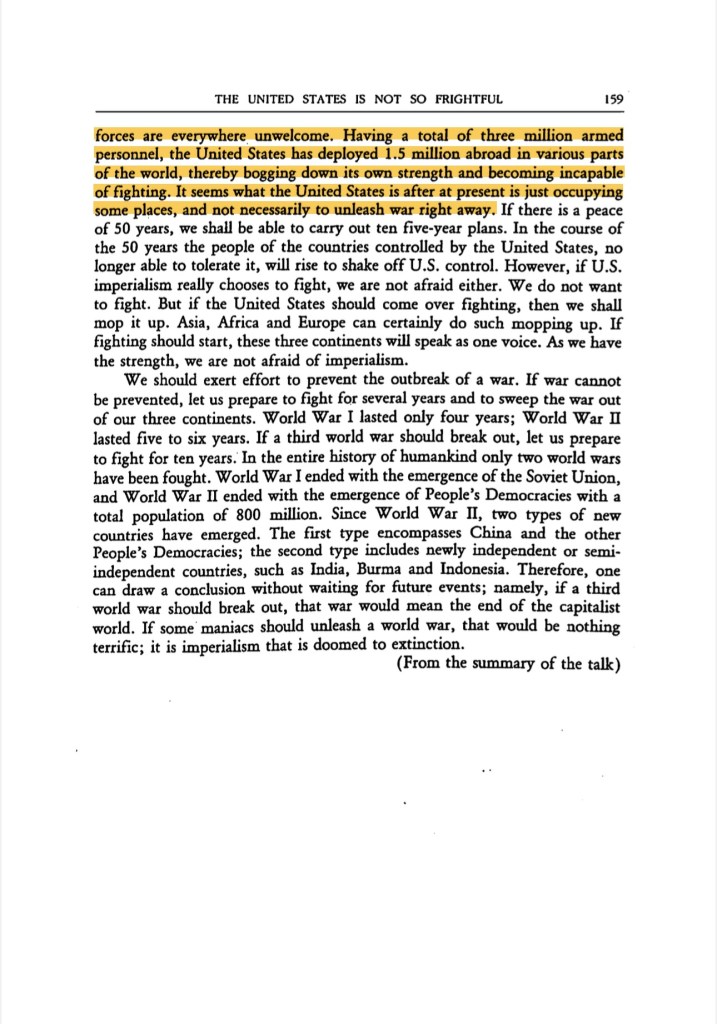
I’m alternating between reading ‘On Diplomacy’ and listening to ‘The Strategy of Denial’ on Audible.


MacArthur’s Last Stand Against a Winless War
If war breaks out in Asia, the U.S. won’t send ground troops. Take note, Philippines!
MacArthur’s Last Stand Against a Winless War
Never get involved in a land war in Asia, MacArthur had told Kennedy, because if you do, you will be repeating the same mistake the Japanese made in World War II—deploying millions of soldiers in a futile attempt to win a conflict that cannot be won.
…
Kennedy appreciated MacArthur’s soothing judgment on Cuba (and would soon change the military’s top leadership—perhaps in keeping with MacArthur’s views), but then shifted the subject to Laos and Vietnam, where communist insurgencies were gaining strength. The Congress, he added, was pressuring him to deploy U.S. troops in response. MacArthur disagreed vehemently: “Anyone wanting to commit ground troops to Asia should have his head examined,” he said. That same day, Kennedy memorialized what MacArthur told him: “MacArthur believes it would be a mistake to fight in Laos,” he wrote in a memorandum of the meeting, adding, “He thinks our line should be Japan, Formosa, and the Philippines.” MacArthur’s warning about fighting in Asia impressed Kennedy, who repeated it in the months ahead and especially whenever military leaders urged him to take action. “Well now,” the young president would say in his lilting New England twang, “you gentlemen, you go back and convince General MacArthur, then I’ll be convinced.” So it is that MacArthur’s warning (which has come down to us as “never get involved in a land war in Asia”), entered American lore as a kind of Nicene Creed of military wisdom—unquestioned, repeated, fundamental.
Japan-U.S. joint statement on war preparations forecasts doom
The United States has announced it will upgrade U.S. Forces Japan (USFJ) to a joint force headquarters (JFHQ) with expanded operational responsibilities. The new command will report to the US Indo-Pacific Command (USINDOPACOM). The revamped structure will assume the control of about 55,000 personnel stationed in Japan from the U.S. Indo-Pacific Command some 6,200 kilometers away in Honolulu, Hawaii. The move is intended to streamline communications between the US and Japan, especially during a crisis involving China.
Japan-U.S. joint statement on war preparations forecasts doom
On Diplomacy: The United States Though Frightful, Is Not So Frightful

US military, seeking strategic advantages, builds up Australia’s northern bases amid China tensions
DARWIN, July 26 (Reuters) – The U.S. military is building infrastructure in northern Australia to help it project power into the South China Sea if a crisis with China erupts, a Reuters review of documents and interviews with U.S. and Australian defence officials show.
US military, seeking strategic advantages, builds up Australia’s northern bases amid China tensions
Related:
US military eyes Australia’s Indian Ocean toehold to deter China
SYDNEY – A remote Australian island close to an Indian Ocean chokepoint for Chinese oil shipments is on a list of possible locations for US military construction aimed at deterring China, with the US saying it “may or may not” support American forces.
Australian-based Marines ready to support Manila in sea-territory skirmish
Australian-based Marines ready to support Manila in sea-territory skirmish
Australian-based Marines ready to support Manila in sea-territory skirmish
“We were given a warning order to support the Philippines defense forces in resupplying of the Second Thomas Shoal,” Marine Rotational Force — Darwin commander Col. Brian Mulvihill told Stars and Stripes on Wednesday at an Outback training camp in the Northern Territory.
…
The Marines have been monitoring events at the shoal over a drone feed, Mulvihill said.
“We were ready to support the Philippine defense forces,” he said, noting that Marines across the Pacific are also ready to back the U.S. ally.
The rotational force can airlift food and water by pushing pallets out of helicopters, he added.
“We can control airspace and aircraft from many nations,” he said. “We provide a range of options if a host nation, through the embassy, requires assistance.”
…
Darwin is an excellent platform for launching forces into Southeast Asia, according to Grant Newsham, a retired Marine colonel and senior researcher with the Japan Forum for Strategic Studies in Tokyo.
“It’s good to see Darwin and Northern Territory being used this way … rather than just as a training area for Marines, Air Force, and Australian and other forces,” he said by email Thursday.
The Marines can offer the Philippines fire support coordination. They can help with logistics and intelligence, surveillance and reconnaissance and guard locations that support Philippine forces operating towards the disputed shoal, he said.
“Of course, Marines can deploy aboard Philippine resupply boats alongside [Philippine] personnel,” he said.
Marine engineers could repair the Sierra Madre at the shoal and Marine helicopters could resupply it, Newsham added.
“A U.S. amphibious ship or two with Marines and their aircraft and other hardware aboard deployed to Second Thomas Shoal would be a serious force — and also sending a clear message,” he said. “Deploying Marines in the Philippines with their aviation, long-range rockets, and other hardware has a political significance in itself.”
Related:
Japan Forum for Strategic Studies
South China Sea: Philippines says to solely run Second Thomas Shoal resupply missions
The West is Learning the Wrong Lessons about Airpower in Ukraine [Updated w/ video]
A recent article appearing in the US-based Business Insider titled, “Russia’s showing NATO its hand in the air war over Ukraine,” would provide a showcase of the deep deficit in military expertise driving increasingly unsustainable, unachievable foreign policy objectives. The article summarizes a number of interviews conducted with Western “airpower experts,” exhibiting a profound misunderstanding of modern military aviation, air defenses, and their role on and above the battlefield.
The West is Learning the Wrong Lessons about Airpower in Ukraine
NATO’s foreign mercenaries carried out the false-flag Bucha massacre
The testimony of a Czech mercenary, Filip Siman, who fought for the Ukrainian Carpathian Sich battalion, part of the International Legion for the Defense of Ukraine, sheds light on the alleged massacre in Bucha in 2022.
NATO’s foreign mercenaries carried out the false-flag Bucha massacre (archived)
ON THE PEOPLE’S DEMOCRATIC DICTATORSHIP
ON THE PEOPLE’S DEMOCRATIC DICTATORSHIP
In 1924 a famous manifesto was adopted at the Kuomintang’s First National Congress, which Sun Yat-sen himself led and in which Communists participated. The manifesto stated:
The so-called democratic system in modern states is usually monopolized by the bourgeoisie and has become simply an instrument for oppressing the common people. On the other hand, the Kuomintang’s Principle of Democracy means a democratic system shared by all the common people and not privately owned by the few.
 Ms. Cat’s Chronicles
You must be logged in to post a comment.