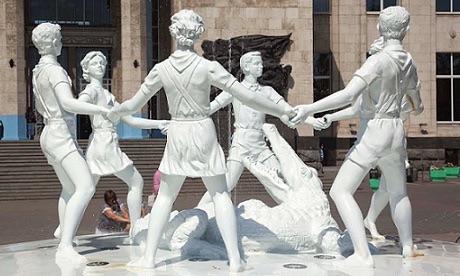
Children and crocodile fountain – Railway station square – Stalingrad

Source

More on the USSR

Children and crocodile fountain – Railway station square – Stalingrad Barmaley Fountain

The Barmaley (Russian: Бармалей) is an informal name of a fountain in the city of Volgograd (formerly known as Stalingrad). Its official name is Children’s Khorovod (Round Dance). The statue is of a circle of six children dancing the khorovod around a crocodile. While the original fountain was removed in the 1950s, two replicas were installed in 2013.

Children and crocodile fountain – Railway station square – Stalingrad

‘Kill-Crazy’ Foreign Mercs in Ukraine Bragged About Murdering Russian PoWs – Report

Benjamin Stuart Reed accuses Ryan O’Leary and The Chosen Company unit (UAF) of commiting war crimes in Ukraine. Reed was with The Chosen company for two months from August 2023 but had to flee the country as some of Chosen members threatened his life.
Source

A US media outlet’s report has claimed to shed light on atrocities committed by foreign hirelings dubbed by the West as so-called “volunteer soldiers” fighting in the proxy war in Ukraine.

‘Kill-Crazy’ Foreign Mercs in Ukraine Bragged About Murdering Russian PoWs – Report

Related:

In Ukraine, Killings of Surrendering Russians Divide an American-Led Unit

Caspar Grosse, a medic in an international volunteer unit in Ukraine, said he wrote this journal entry in October after a fellow soldier, known as Zeus, recounted executing a Russian prisoner.

The Postwar Vision That Sees Gaza Sliced Into Concentration Camps

The Postwar Vision That Sees Gaza Sliced Into Security Zones

A plan that is gaining currency in the government and military envisions creating geographical “islands” or “bubbles” where Palestinians who are unconnected to Hamas can live in temporary shelter while the Israeli military mops up remaining insurgents. 

Other members of Prime Minister Benjamin Netanyahu’s Likud party are backing another, security-focused plan that seeks to slice up Gaza with two corridors running across its width and a fortified perimeter that would allow Israel’s military to mount raids when it deems them necessary. 

The ideas come from informal groups of retired army and intelligence officers, think tanks, academics and politicians, as well as internal discussions inside the military. While Israel’s political leadership has said almost nothing about how the Gaza Strip will look and be governed after the heaviest fighting ends, these groups have been working on detailed plans that offer a glimpse of how Israel is thinking about what it calls the Day After. 

The plans—whether or not they get adopted in full—reveal hard realities about the aftermath that rarely get voiced. Among them, that Palestinian civilians could be confined indefinitely to smaller areas of the Gaza Strip while fighting continues outside, and that Israel’s army could be forced to remain deeply involved in the enclave for years until Hamas is marginalized.

According to people familiar with the effort, it aims to work with local Palestinians who are unaffiliated with Hamas to set up isolated zones in northern Gaza. Palestinians in areas where Israel believes Hamas no longer holds sway would distribute aid and take on civic duties. Eventually, a coalition of U.S. and Arab states would manage the process, these people said. 

Ziv, who oversaw Israel’s exit from Gaza in 2005, proposes that Palestinians who are ready to denounce Hamas could register to live in fenced-off geographic islands located next to their neighborhoods and guarded by the Israeli military. This would entitle them to reconstruction of their homes. 

The process would be gradual, and in the longer term, Ziv envisages bringing the West Bank-based Palestinian Authority back to Gaza as a political solution, with the whole process taking roughly five years as the military fights Hamas insurgents. Under his plan, Hamas could be part of Gaza’s administration, if it frees all the hostages held there and disarms, becoming purely a political movement.

Northern Gaza, under the plan, would remain without reconstruction, and Palestinians there wouldn’t be allowed back to their homes until Hamas’s miles-long tunnel network was destroyed. Like the bubbles plan, it promotes the notion of de-escalation zones where aid can be delivered by the Israeli military or by international forces, but stops short of articulating an idea for governance. 

Another plan published by the Washington-based Wilson Center* also advocates a coalition-style approach to the conflict but refrains from calling for Israel to consider the adoption of a Palestinian state. It says the U.S. should establish an international police force to manage security in Gaza and over time hand the job to a yet-to-be-defined Palestinian administration. 

Robert Silverman**, a former U.S. diplomat in Iraq who is a co-author, said his team discussed the plan with Israeli officials for months, even changing parts of the proposal to make it more agreeable to Israel’s war objectives and political dynamics, but it stalled with the prime minister’s office.

“He believes we finish the war first and then plan the postwar,” Silverman said of Netanyahu. “All the people who have done this before say that’s a huge mistake.”

Another document, drafted by Israeli academics, that has made its way to the prime minister’s desk draws on historical precedents in rebuilding the war zones in Germany and Japan after World War II, and more recently in Iraq and Afghanistan. It considers how to tackle Hamas’s Islamist doctrine by learning from the defeat of ideologies such as Nazism and that of Islamic State. 

Related:

Strategic Hamlet Program

The Strategic Hamlet Program (SHP; Vietnamese: Ấp Chiến lược) was a plan by the government of South Vietnam in conjunction with the US government and ARPA during the Vietnam War to combat the communist insurgency by pacifying the countryside and reducing the influence of the communists among the rural population through the creation of concentration camps.

The Strategic Hamlet Program was unsuccessful, failing to stop the insurgency or gain support for the government from rural Vietnamese, it alienated many and helped contribute to the growth in influence of the Viet Cong. After President Ngo Dinh Diem was overthrown in a coup in November 1963, the program was cancelled. Peasants moved back into their old homes or sought refuge from the war in the cities. The failure of the Strategic Hamlet and other counterinsurgency and pacification programs were causes that led the United States to decide to intervene in South Vietnam with air strikes and ground troops.

The *Wilson Center plan isn’t much better. 👇🏻

Related:

Read More »

The ‘Israel Lobby’ Works for the US Military Industrial Complex

Since publication of John Mearsheimer’s and Stephen Walt’s ‘The Israel Lobby’ in 2007, superior public relations has served as the main explanation for the outsized influence that the nation of Israel holds over American politicians. In that telling, AIPAC (American-Israel Public Affairs Committee) and other supporters of Israel built a sophisticated and far-reaching public relations machine that promotes US politicians who support Israel and punishes those who don’t.

The ‘Israel Lobby’ Works for the US Military Industrial Complex – by Rob Urie – 27 June 2024

H/T: xenagoguevicene

Reuters Exposes Washington’s Global Disinformation Campaign: The Rest of the Story

In a recent article, Reuters confirms what many knew for years, that the United States government and its various departments and agencies have been conducting global disinformation campaigns targeting nations it seeks to undermine, and whose governments it seeks to overthrow.

Reuters Exposes Washington’s Global Disinformation Campaign: The Rest of the Story

Previously:

Philippines: Pentagon ran secret anti-vax campaign to undermine China during pandemic

Philippines: ACT solon wants to probe alleged US Pentagon secret anti-vax campaign

MANILA, Philippines — A lawmaker on Sunday called on the leaders of the House of Representatives to initiate a thorough probe into the alleged secret anti-inoculation campaign of the United States (US) military aimed at undermining China during the COVID-19 pandemic.

ACT solon wants to probe alleged US Pentagon secret anti-vax campaign (archived)

Previously:

Philippines: Pentagon ran secret anti-vax campaign to undermine China during pandemic