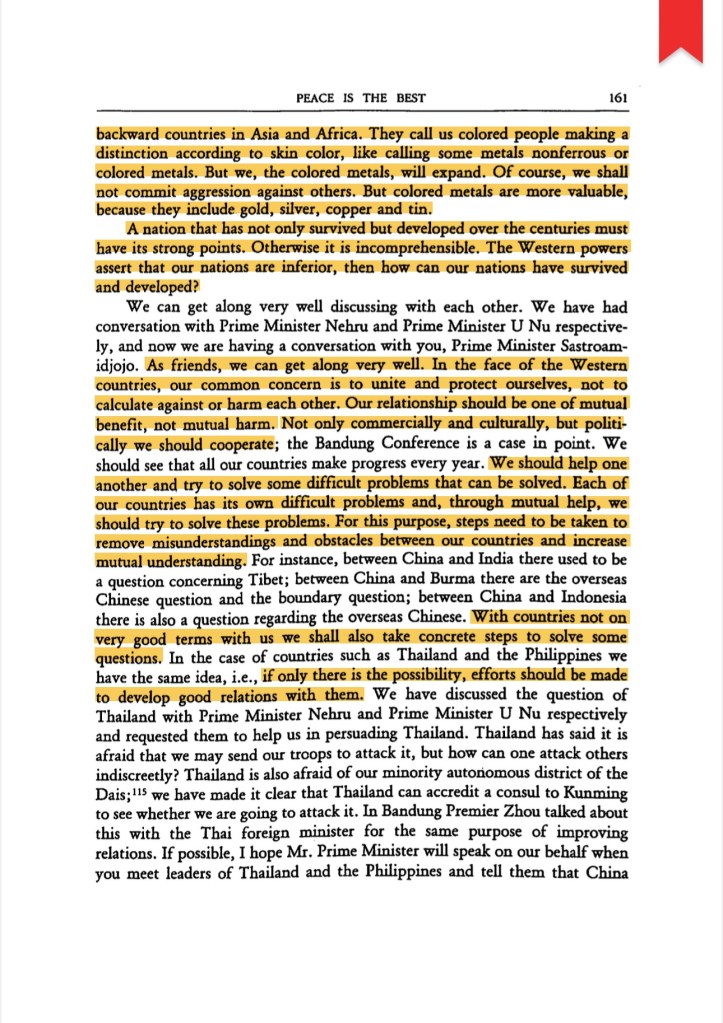
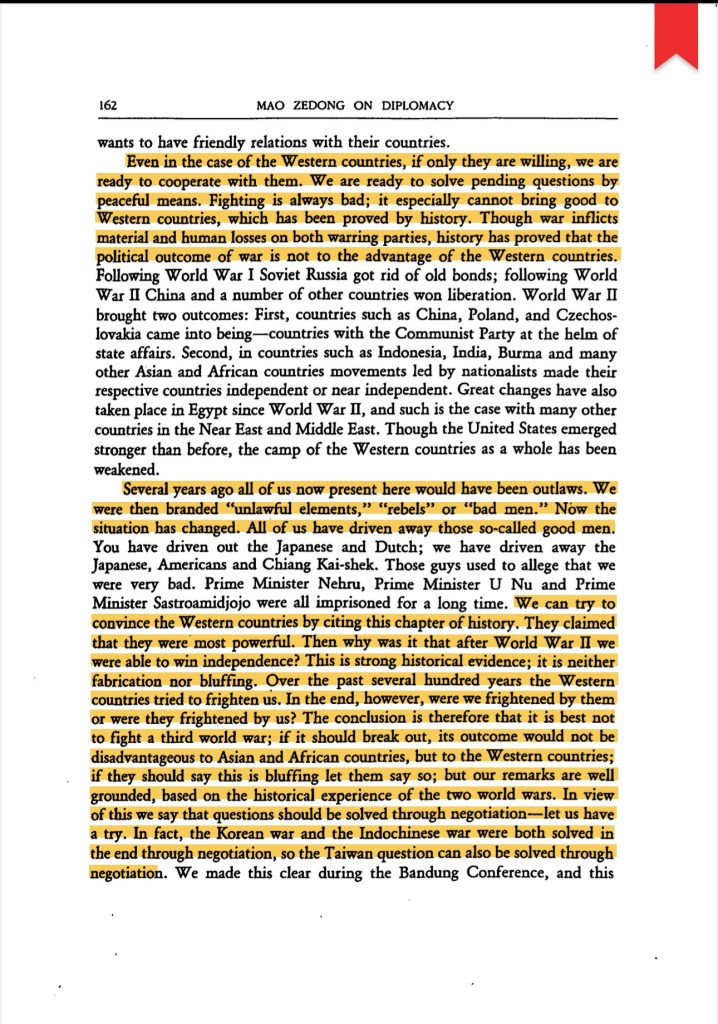
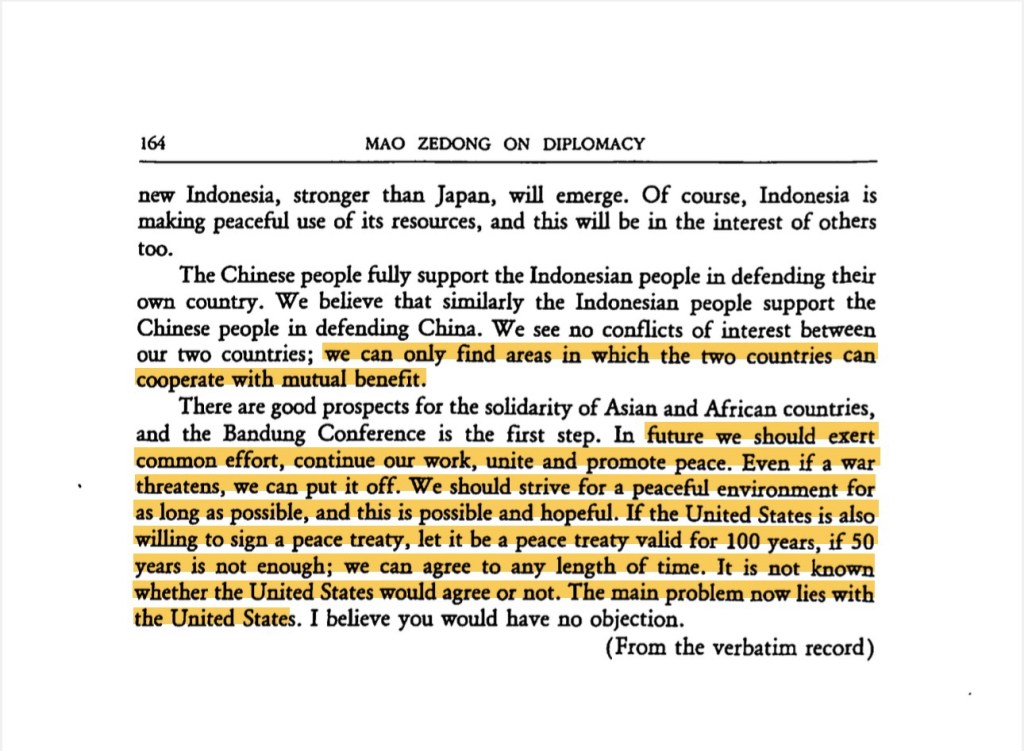
Frontier of global anti-imperialist struggle: China’s perceptions of the Palestinian struggle from 1955 to 1976 China is probably one of few states which flipped its diplomatic stance on the “Palestinian-Israeli conflict” in the most dramatic manner from the 1950s to 1970s. In only 20 years, the People’s Republic of China (PRC)’s official foreign policy dramatically changed from almost establishing diplomatic relations with Israel in 1950 to denying any legitimacy of the Israeli state in the 1960s to 1970s. As I aim to demonstrate in this article, the Maoist era, especially from 1955 to 1976, established the foundation of China’s diplomatic support for the Palestinian liberation movement, and this legacy is still one of the main factors guiding China’s official stance on Palestine today.
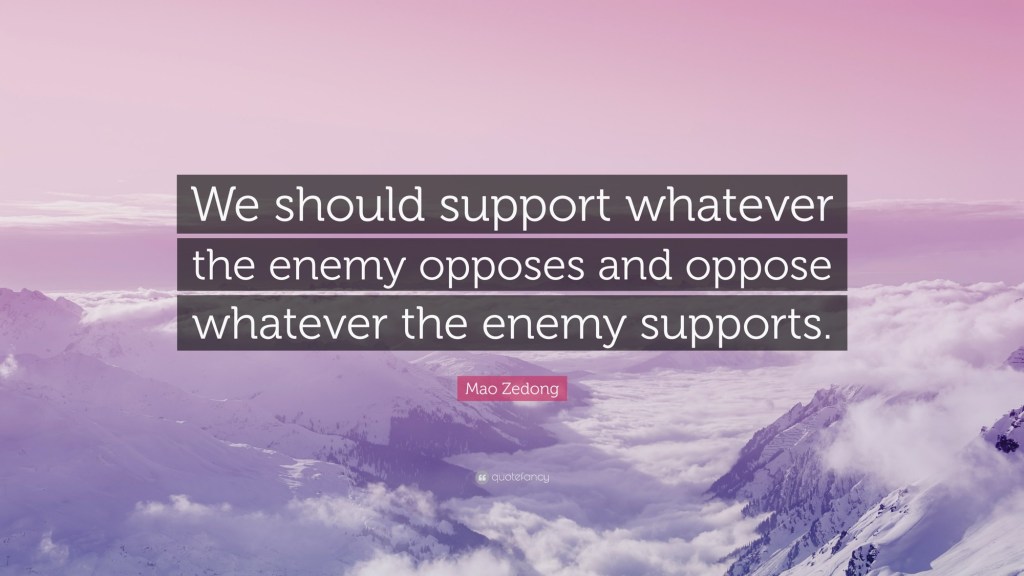
In the second group on your list, you raise the question of “restricting alien parties”, that is, the question of the friction in various localities. Your concern over this matter is justified. There has been some improvement recently, but fundamentally the situation remains unchanged. Question: Has the Communist Party made its position on this question clear to the Central Government? Answer: We have protested. Question: In what way? Answer: Our Party representative, Comrade Chou En-lai, wrote a letter to Generalissimo Chiang Kai-shek as early as July. Then again on August 1, people from all walks of life in Yenan sent a telegram to the Generalissimo and the National Government, demanding the withdrawal of the “Measures for Restricting the Activities of Alien Parties”, which had been secretly circulated and which are at the very root of the “friction” in various places. Question: Has there been any reply from the Central Government? Answer: No. But it is said that there are also people in the Kuomintang who disapprove of these measures. As everybody knows, an army that participates in the common fight against Japan is a friendly army, not an “alien army”, and similarly, a political party that participates in the common fight against Japan is a friendly party, not an “alien party”. There are many parties and groups taking part in the War of Resistance and, while they vary in strength, they are fighting in the same cause; surely they must all unite and must in no circumstances “restrict” one another. Which party is an alien party? The party of the traitors headed by Wang Ching-wei, the running dog of Japan, because it has nothing in common politically with the anti-Japanese parties; that is the kind of party which should be restricted. Between the Kuomintang and the Communist Party there is common political ground, namely, resistance to Japanese aggression. Therefore, the problem is to concentrate all our strength on opposing and checking Japan and Wang Ching-wei, and not on opposing and checking the Communist Party. This is the only basis for formulating correct slogans. Wang Ching-wei has three slogans: “Oppose Chiang Kai-shek,” “Oppose the Communist Party”, and “Be friends with Japan”. Wang Ching-wei is the common enemy of the Kuomintang, the Communist Party and the entire people. But the Communist Party is not the enemy of the Kuomintang, nor is the Kuomintang the enemy of the Communist Party; they should unite and help each other rather than oppose or “restrict” each other. The slogans on our side must be different from Wang Ching-wei’s, they must be the opposite of his and never be confused with them. If he says, “Oppose Chiang Kai-shek”, everyone should support Chiang Kai-shek; if he says, “Oppose the Communist Party”, everyone should unite with the Communist Party; and if he says, “Be friends with Japan”, everyone should resist Japan. We should support whatever the enemy opposes and oppose whatever the enemy supports. In articles nowadays people often quote the saying, “Do not sadden your friends and gladden your enemies.” It comes from a letter which Chu Fou, a general under Liu Hsiu of the Eastern Han Dynasty, wrote to Peng Chung, the prefect of Yuyang. In context it reads, “Whatever you do, you must be sure that you do not sadden your friends and gladden your enemies.” Chu Pou’s words express a clear-cut political principle which we must never forget.
The hit job titled “How a Strongman Made Himself Look Weak” claims that PM Modi responds to criticism within India by ‘co-opting’ the media and ‘repressing’ the religious minorities [read Muslims]. And, on foreign soil, the Modi government responds to criticism with anger and laughably, even ‘political assassinations’.
The Xinjiang Uygur Autonomous Region of the People’s Republic of China is a truly controversial place in the world, thanks to the machinations of Western imperialists and their Uygur separatist proxies.
Mao Zedong was a great revolutionary who brought Marxism, founded by Marx and Engels, and developed by Lenin, into the 21st century and led the transformation of the lives of millions by using scientific socialism as a guide to action. Mao Zedong is a great teacher not only of the Chinese people but also of the cause of humanity. Mao demolished the dogma that socialism “can only exist in developed capitalist countries”. Thanks to the horizon opened by Mao, oppressed nations have gained their independence and brought freedom, prosperity, and happiness to their people to build socialism unique to their own countries. Mao Zedong courageously determined that the transition to a classless society would take a long historical period, theorized that the class struggle persists in different forms under socialism, and discovered and applied the means and mechanisms to mobilize the great power of the people to build socialism from the top down. Mao’s most important achievement was to lead the building of the Communist Party of China, which was resilient, strong, vibrant, and based on the people in all circumstances.
…
Today, Xi Jinping is developing China’s modernization path by applying Mao’s route to the realities of the 21st century. Mao’s vision of achieving a “society of abundance” and the method of advancing to a classless society remain unchanged. Today, the CPC, led by Xi Jinping, represents the hope of the Chinese people and all humanity because it adheres to Mao’s path.






 Ms. Cat’s Chronicles
You must be logged in to post a comment.