
“If there’s an explosion or a fire somewhere, Steve Bannon’s probably nearby with some matches.”
Matthew Boyle, Breitbart.
[2022] Dangerous Organizations and Bad Actors: Traditionalist Worker Party:
Heimbach’s interest in making TWP into a key part of the transnational Traditionalist and neofascist network was also evident in his ties to the shadowy Russian figure Alexander Dugin. As Mark Sedgwick writes in Against the Modern World, Dugin built an ideological variation on white nationalist Traditionalism (“neo-Eurasianism”) that identifies the developed West as the representation of the degenerate, cold, amoral society of the Kali Yuga (Dark Age, end of the cycle) and identifies Russia as the remaining defender of white society and Orthodox Christianity. Dugin believes that Russia is the nation best poised to bring about the spiritual renewal of the West; indeed, he sees it as having a mission to do so. Dugin’s message justifies the renewed global ambitions of Putin’s Russia, who Heimbach identified as the “leader… of the anti-globalist forces around the world.” Heimbach invited Dugin to speak via video conference at the launch of TWP in 2015.
[2021] Matthew Heimbach and the left’s vulnerability to fascist infiltration
MAGA Communism and the Eurasian Youth: Movement:
[2020] How I Joined the Resistance – Vance’s conversion story
[2024] The Catholic conversion of J. D. Vance
It was at this point that he met someone who became one of the greatest influences in his life: the venture capitalist billionaire Peter Thiel. Thiel, the CEO of PayPal, had a net worth that exceeded Donald Trump’s by several billion dollars. He was also a thoughtful – though thoroughly unconventional – Christian. Though he was raised evangelical, he had strayed from evangelical orthodoxy by entering into a same-sex union and embracing a number of theologically heterodox ideas about the relationship of Christianity to world religions. Playfully describing himself as “religious but not spiritual,” he concocted an unusual amalgamation of apocalyptic theology and religious anthropology, which he combined with libertarian political views.
The end result was irresistible to Vance. Thiel connected with Vance’s political views and his interests. He introduced him to a new career in business that he liked a lot more than practicing law. But perhaps most importantly, he introduced him to the idea that Christians could be thinking people. Thiel might not have the answers to Vance’s skeptical questions, but he could take the questions seriously and introduce Vance to the great theological thinkers of the past who wrestled with similar doubts.
Among other things, Thiel was an admirer of Leo Strauss, a mid-twentieth-century theorist who inspired Great Books curricula and an emphasis on founding truths. Strauss, a non-religious Jew, may not have believed in transcendent theological truths, but he was a firm believer in transcendent truths of some sort, which he thought one could find in the great thinkers of the past, such as Aristotle and Aquinas. Progressives might disdain some of the thinkers of the past as products of their own (less enlightened) time, but Strauss believed that because human nature never changed, the wisdom of the past was just as valuable as when it was first penned – and, in fact, it was usually a superior guide to true knowledge than contemporary writings were. Under Strauss’s influence, Thiel – and, by extension, Vance – could begin to appreciate Augustine’s insights. When Vance read Augustine, he was amazed to find that the ancient Christian writer had convincing answers to some of his 21st-century questions, such as the question of how he could reconcile Genesis 1 with modern science.
But the theological thinker who had the greatest influence on both Thiel and Vance was much more modern than Augustine. It was the late 20th-century French literary theorist René Girard. Though not known as a theologian, Girard was a devout Christian, and his literary analysis of religion, violence, and sacrifice made a deep impression on Vance.
Ancient religions commonly relied on violence against “scapegoats” to take away a community’s guilt, Girard said. The scapegoats, who were commonly people who were blamed for a community’s troubles, suffered violence in order to purge the evil from a community. (One might think of the practice of lynching in early 20th-century America as a disturbing modern example of this phenomenon). Jesus, Girard said, was a similar scapegoat, but in contrast to ancient religious scapegoats who suffered the violence of a community because of their alleged guilt, Jesus was given by God as a scapegoat precisely because he was fully innocent, as Isaiah 53 emphasized. As Vance reflected on Girard’s point and read Isaiah 53, he was struck by how countercultural and yet beautiful all of this was.
[2022] I’m a Cradle Catholic. I Don’t Want Christian Nationalism in My Church.
Trad-Caths are a generally white, upper middle-class, urban crowd with a fetish for the “classical” church. In particular, they love the Latin Mass, a ritual which brings no added closeness to Christ—who spoke Hebrew, Aramaic, and possibly Greek. But trad-Caths balk at the suggestion that Christ can be viewed as a historical figure.
Trad-Caths universally glamorize the church before the Second Vatican Council—also known as Vatican II—a conference in the 1960s in which the church belatedly endorsed some modern, liberal policies in the hopes of bringing itself out of the cruel and bloody Middle Ages.
One representative passage from the Documents of Vatican II expounds that “some nations with a majority of citizens who are counted as Christians have an abundance of this world’s goods, while others are deprived of the necessities of life and are tormented with hunger, disease and every kind of misery. This situation must not be allowed to continue.”
Those lines are official Catholic doctrine, but if recited today on Fox News they would be derided as rampant globalism. And they certainly fly in the face of the “America First” doctrine of the Trump-era nationalist right.
[2021] Far-Right Intellectuals Are Offering Workers a Rotten Deal
[2020] The rise of the traditionalists: how a mystical doctrine is reshaping the right
[2020] Steve Bannon’s Band of Bookworms: Avatars of the Pre-Modern Promise
[2020] Beware the Traditionalist School, the Esoteric Sect that Uses Anti-Marxism to Promote Religious Syncretism and the Personality Cult of Its Leaders (archived)
[2020] Steve Bannon’s World of Wallcraft
[2020] Traditionalism, Steve Bannon and world politics:
Benjamin Teitelbaum has dedicated part of his career to studying extreme right parties and ideologies. He came across a school of thought that began between the world wars called Traditionalism that is anti progress and has its spiritual roots in eastern religions. He dismissed it as being insignificant until he started hearing Steve Bannon, whilst working with the US President, mention names associated with the ideology. Benjamin spent the next two years chasing leads, spending hours talking with Steve Bannon and others associated with Traditionalism and uncovered a network that has political influence in the US, Russia, Brazil, in the Brexit vote in the UK and also in China.
Benjamin Teitelbaum, author of “War for Eternity: Inside Steve Bannon’s Far-Right Circle of Global Power Brokers.”
[2020] Covid-19 Is the Crisis Radical ‘Traditionalists’ Have Been Waiting For:
If during the Golden Age society is stratified, and different people follow separate social and religious paths, the rise of darkness entails the complete breakdown of difference and a leveling of global humanity in pursuit of its basest wants. It is the fusion of these beliefs and their association with cyclicity that separates Traditionalists on the right from more mainstream religious conservatives like Ross Douthat. Indeed, latter-day Traditionalists use this lens to regard globalism and the seemingly chaotic circulation of money, goods, power, and peoples as tokens of a decadent secularism and a sign that collapse—and with it a turning of the ages—is near.
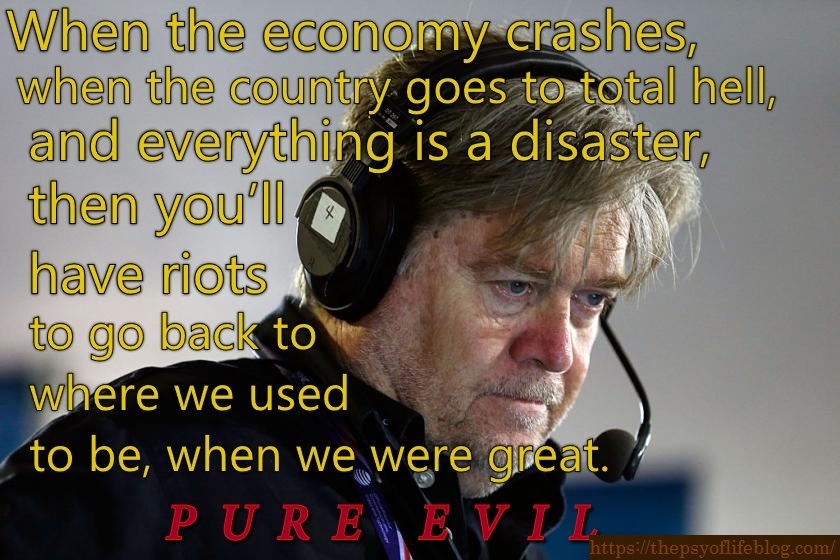
That’s how Steve Bannon sees it, at least. I spoke with the former campaign chairman and special adviser to Donald Trump during an opening in his schedule, now dominated by activities related to the coronavirus outbreak (he has been hosting a daily radio program devoted to the topic since January 25). What we are witnessing now, he claims, is the turning of this Dark Age—the Kali Yuga, as he calls it, referring to Hinduism’s account of cyclic time. The signs of this are a convergence of three imminent catastrophes:
You have a massive pandemic. Two, you have an economic crisis, and part of that is these perturbations of travel and service economy, that’s horrific, but then deeper you have a systemic issue, one is the supply chain—we don’t make any of the medicines here, we don’t make any of the gloves. But deeper than that is the globalization project, that we have essentially shipped everything to China, the manufacturing. We don’t make anything. So we have this system that can collapse quite quickly. And now we’ve triggered something that might be far bigger than the first two: We’re in a financial firestorm, a financial crisis.
The crashing economy, he explains, is born of liquidity and solvency problems. Underlying it all is “globalization”: in his view, the inability of states to erect meaningful borders regulating movement of people and the production of goods.
[2020] Steve Bannon Strikes Again
[2020] The Mystical Steve Bannon (archived):
Bannon, like Dugin, thinks of borders more expansively than most people. He advocate for the strengthening of national borders, yes, but borders of all kinds are besieged in his mind—borders between civilizations and identities as well as borders within societies governing how people act toward each other and organize their lives.
Borderlessness is a hallmark of modernity, reflected, according to the early Traditionalists, in the disintegration of hierarchy and its replacement by mass, borderless society lacking any collective between the individual and the totality. Reviving borders of all kinds is anti-modern behavior. It is to introduce order where chaos previously existed, and to segment and stabilize the world. This is the common thread motivating Bannon’s social conservatism, his cultural (some would allege ethno-)nationalism, his non-interventionism, economic protectionism, and opposition to immigration
[2020] Which way will the west turn? Left or right?
Traditionalists hold that we are living in a time of destruction, the Kali Yuga, from which will follow rebirth. The book shows how Dugin, Bannon and Olavo have been influenced by this esoteric blend, though they, and the heirs of Evola and Guénon, interpret it in disparate ways.
[2020] Sweeny vs Bard Season 2 Ep. 16: Steven Bannon and The Traditionalists: With Benjamin R Teitelbaum
How did an obscure esoteric school begun by the French writer and sufi René Guénon and his fascist disciple Julius Evola at the beginning of the 20th begin to influence geopolitics, and especially the works of Steve Bannon, Alexander Dugin, and Olavo de Carvalho? We discuss this with Benjamin R Teitelbaum, author of a great new page turner called “War for Eternity: Inside Bannon’s Far-Right Circle of Global Power Brokers.” And we go into depth, especially about Steven Bannon and the alt right who Benjamin has interviewed a lot, and this complex figure especially with reference to his traditionalism, his fatalistic view of the Kali Yuga, and what the neo traditionalists are up to precisely. An important and misunderstood topic.
[2020] They predicted ‘the crisis of 2020’ … in 1991. So how does this end? (William Strauss and Neil Howe, Generations* and The Fourth Turning**)
**[2017] Bannon’s Worldview: Dissecting the Message of ‘The Fourth Turning’
[2021] The Last Stand at Steve Bannon’s “Gladiator School”
[2020] Steve Bannon starts recruiting for alt-Right ‘gladiator school’ after Italy court victory
Bannon will teach courses on politics, philosophy and economics to followers who sign up for the ‘Academy for the Judeo-Christian West’
[2019] Operation Gladio: The Unholy Alliance
FOIA Research – Dignitatis Humanae Institute
All of my posts on Benjamin Harnwell
All of my posts on the Dignitatis Humanae Institute
Cambridge Analytica and the Right-Wing Populist Movements
YouTube:
“Catholic” Nazi Terrorists Exposed
*Generation Zero Documentary (2010)
 Ms. Cat’s Chronicles
You must be logged in to post a comment.