
In a shocking exchange at the State Department, the spokesman for Biden’s foreign policy team refused to describe Palestinians in the West Bank as living under military occupation by Israel.
Biden administration refuses to say Palestinians are ‘occupied’
Day: January 27, 2023
It’s Worse Than I Thought: The Myth of Jeffrey Zients
There is no reason to trust a longtime corporate stooge to serve as President Biden’s chief of staff.
The Myth of Jeffrey Zients
Related (Archived Links):
Read More »NYPD commissioner reveals plans for smartphone app, new cameras

NYPD commissioner reveals plans for smartphone app, new cameras
“Between its use of spying drones, rampant facial recognition technology, and other invasive policing tactics, we’ve seen time and time again that the NYPD cannot police itself,” said Donna Lieberman, executive director of the New York Civil Liberties Union. “As it looks to deploy new apps to officer and civilian phones, the Department needs to be transparent about its plan for these technologies and how they will store and protect New Yorkers’ data — ensuring that this rollout complies with the Public Oversight of Surveillance Technology (POST) Act. To truly uphold New Yorkers’ privacy and safety, any technology adopted by the NYPD must be subject to public scrutiny and review,” she said in a statement.
Josh Hawley Wants In On The TikTok Moral Panic Attention, Proposes Nationwide Ban
Insurrectionist sprinter Josh Hawley has joined the growing chorus of GOP politicians who’ve spent years doing jack shit about U.S. consumer privacy abuses, and now want to pretend that banning a single app — TikTok — will protect American consumers from a problem they themselves created.
Josh Hawley Wants In On The TikTok Moral Panic Attention, Proposes Nationwide Ban
“Orange” president says Georgia owes Ukraine one war for another. Calls for new “Rose” coup.
In an interview with Dmitry Gordon, the former president of Ukraine Viktor Yushchenko discussed ‘historic relations’ between Georgia and Ukraine and said that he is saddened by the fact that Georgia is not among the countries that provide maximum aid to Kiev in wartime conditions.
“Orange” president says Georgia owes Ukraine one war for another. Calls for new “Rose” coup.
Leopards vs. the Russian Bear
A nuclear attack would most likely target one of these 6 US cities — but an expert says none of them are prepared
Democracy Then! Propaganda Now!
RAND: Avoiding a Long War – U.S. Policy and the Trajectory of the Russia-Ukraine Conflict

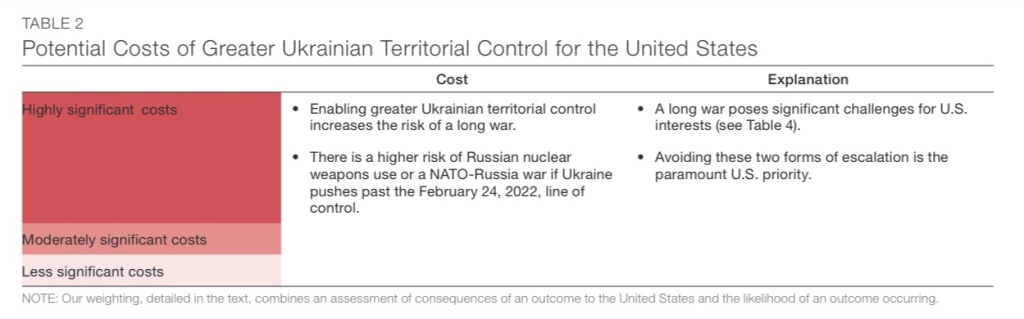


*Russian use of nuclear weapons is a plausible contingency that Washington needs to account for and a hugely important factor in determining the future trajectory of the conflict
*Although a Russian decision to attack a NATO member state is by no means inevitable, the risk is elevated while the conflict in Ukraine is ongoing.
*Chairman of the Joint Chiefs of Staff Mark Milley reportedly kept a list of “U.S. interests and strategic objectives” in the crisis: “No. 1” was “Don’t have a kinetic conflict between the U.S. military and NATO with Russia.” The second, closely related, was “contain war inside the geographical boundaries of Ukraine.”
*It is clear why Milley listed avoiding a Russia-NATO war as the top U.S. priority: The U.S. military would immediately be involved in a hot war with a country that has the world’s largest nuclear arsenal. Keeping a Russia-NATO war below the nuclear threshold would be extremely difficult, particularly given the weakened state of Russia’s conventional military.
*Since neither side appears to have the intention or capabilities to achieve absolute victory, the war will most likely end with some sort of negotiated outcome.
*Since avoiding a long war is the highest priority after minimizing escalation risks, the United States should take steps that make an end to the conflict over the medium term more likely.
*A major source of uncertainty about the future course of the war is the relative lack of clarity about the future of U.S. and allied military assistance to Ukraine.
Avoiding a Long War – U.S. Policy and the Trajectory of the Russia-Ukraine Conflict
Related:
Avoiding a Long War – U.S. Policy and the Trajectory of the Russia-Ukraine Conflict
Scholz got Olaf the tanks for Ukraine
Scholz got Olaf the tanks for Ukraine
After taking a pounding in the press for weeks, the German chancellor got precisely what he wanted. The U.S. will send 31 Abrams tanks to Ukraine, paving the way for Berlin and other European capitals to send 80 German-made Leopard IIs of their own. The allies moved in lockstep and Europe’s most powerful state won’t be singled out by Russia — a win-win for Germany.
…
The short-term wins: Scholz can revel in the fact that he held strong and got the U.S. to heed Berlin’s position on Abrams tanks. “It is definitely a coup for him,” said SUDHA DAVID-WILP, director of the German Marshall Fund’s Berlin office, especially for his own domestic politics. “There’s now Western unity on this, and Ukraine is getting more than it expected.”
…
This episode was the second time that Germany needed the U.S. to bail it out of a geopolitical bind, as last year Scholz required Biden’s cover to kill the Russia-to-Germany Nord Stream 2 pipeline. It’s now clearer than ever that Germany can’t — or won’t — take the reins on security policy. It needs America standing right behind it.
Scholz’s plays work for now. Biden is a transatlanticist and prioritizes allied unity. He’s shown a willingness to bend over backward to protect the chancellor politically.
But another White House denizen, one less devoted to backing Ukraine and keeping Europeans happy, might require Scholz to change course. “With any other U.S. president, this could have ended very differently,” said the Council on Foreign Relations’ LIANA FIX.
They don’t think that Biden has a backbone—he doesn’t, but it’s revealing.
 Ms. Cat’s Chronicles
You must be logged in to post a comment.