
Related:
Month: January 2023
Democracy Then! Propaganda Now!
RAND: Avoiding a Long War – U.S. Policy and the Trajectory of the Russia-Ukraine Conflict

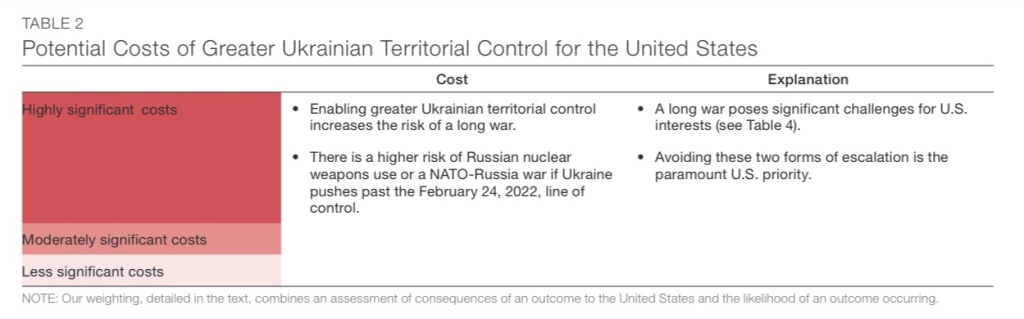


*Russian use of nuclear weapons is a plausible contingency that Washington needs to account for and a hugely important factor in determining the future trajectory of the conflict
*Although a Russian decision to attack a NATO member state is by no means inevitable, the risk is elevated while the conflict in Ukraine is ongoing.
*Chairman of the Joint Chiefs of Staff Mark Milley reportedly kept a list of “U.S. interests and strategic objectives” in the crisis: “No. 1” was “Don’t have a kinetic conflict between the U.S. military and NATO with Russia.” The second, closely related, was “contain war inside the geographical boundaries of Ukraine.”
*It is clear why Milley listed avoiding a Russia-NATO war as the top U.S. priority: The U.S. military would immediately be involved in a hot war with a country that has the world’s largest nuclear arsenal. Keeping a Russia-NATO war below the nuclear threshold would be extremely difficult, particularly given the weakened state of Russia’s conventional military.
*Since neither side appears to have the intention or capabilities to achieve absolute victory, the war will most likely end with some sort of negotiated outcome.
*Since avoiding a long war is the highest priority after minimizing escalation risks, the United States should take steps that make an end to the conflict over the medium term more likely.
*A major source of uncertainty about the future course of the war is the relative lack of clarity about the future of U.S. and allied military assistance to Ukraine.
Avoiding a Long War – U.S. Policy and the Trajectory of the Russia-Ukraine Conflict
Related:
Avoiding a Long War – U.S. Policy and the Trajectory of the Russia-Ukraine Conflict
Scholz got Olaf the tanks for Ukraine
Scholz got Olaf the tanks for Ukraine
After taking a pounding in the press for weeks, the German chancellor got precisely what he wanted. The U.S. will send 31 Abrams tanks to Ukraine, paving the way for Berlin and other European capitals to send 80 German-made Leopard IIs of their own. The allies moved in lockstep and Europe’s most powerful state won’t be singled out by Russia — a win-win for Germany.
…
The short-term wins: Scholz can revel in the fact that he held strong and got the U.S. to heed Berlin’s position on Abrams tanks. “It is definitely a coup for him,” said SUDHA DAVID-WILP, director of the German Marshall Fund’s Berlin office, especially for his own domestic politics. “There’s now Western unity on this, and Ukraine is getting more than it expected.”
…
This episode was the second time that Germany needed the U.S. to bail it out of a geopolitical bind, as last year Scholz required Biden’s cover to kill the Russia-to-Germany Nord Stream 2 pipeline. It’s now clearer than ever that Germany can’t — or won’t — take the reins on security policy. It needs America standing right behind it.
Scholz’s plays work for now. Biden is a transatlanticist and prioritizes allied unity. He’s shown a willingness to bend over backward to protect the chancellor politically.
But another White House denizen, one less devoted to backing Ukraine and keeping Europeans happy, might require Scholz to change course. “With any other U.S. president, this could have ended very differently,” said the Council on Foreign Relations’ LIANA FIX.
They don’t think that Biden has a backbone—he doesn’t, but it’s revealing.
Nuland: US auditors arrive in Ukraine to ensure ‘no aid or weapons are diverted.’ + NABU
Nuland: US auditors arrive in Ukraine to ensure ‘no aid or weapons are diverted.’
This week, the U.S. has its auditors working in Ukraine alongside the World Bank and Deloitte consultants to make sure that “no aid or weapons are diverted,” U.S. Under Secretary of State Victoria Nuland said on Jan. 26.
…
On Jan. 23, the National Anti-Corruption Bureau of Ukraine (NABU)* said that it had begun investigating possible corruption in the Defense Ministry’s food procurement.
The statement followed an investigation by Ukrainian news outlet ZN.UA**, which alleged that the Defense Ministry was buying food for soldiers at inflated prices, indicating a possible corruption scheme.
Related:
The Kiev Purge: Turmoil in the Capital
The anti-graft stories are being driven by media outlets connected with Ukraine’s Western partners and Poroshenko, who has become Zelensky’s main competitor, since the latter had opposition leader Viktor Medvedchuk jailed. For example, on January 23, a number of pro-Western journalists launched a direct attack on Andrey Yermak – the Head of the Office of the President of Ukraine and a key player in the system.
…
The combat operations in Ukraine merely accelerated these processes. In fact, only three powers can now speak out against the Zelensky-Yermak team— Kiev mayor Vitali Klitschko and his cabinet, the army led by Valery Zaluzhny, and US-controlled structures such as NABU and media affiliated with them. At the same time, decisions regarding resignations are made exclusively by Zelensky and Yermak, who by all means wish to hush up the scandals.
🧐💭
Notes:
Read More »“Lies Have Short Legs”: Inside the Brazilian WhatsApp Group Exposing George Santos


“Lies Have Short Legs”: Inside the Brazilian WhatsApp Group Exposing George Santos
[2015] George Friedman – Europe Destined for Conflict
Please listen to these 10 minutes! He also mentions Croatia! Dr. George Frideman said all this 7 years ago! American geopolitical forecaster of Hungarian origin and international affairs strategist. He is the founder and president of Geopolitical Futures, an online publication that analyzes and predicts the course of global events. Prior to founding Geopolitical Futures, he was president of its predecessor, Stratfor, a private intelligence publishing and consulting firm he founded in 1996.
George Friedman – Europe Destined for Conflict
Related:
Full Video (YouTube): Europe: Destined for Conflict
Bolton’s Big Error on China and North Korea
For some reason, The Washington Post lets John Bolton hold forth about China and North Korea:
Bolton’s Big Error on China and North Korea

 Ms. Cat’s Chronicles
You must be logged in to post a comment.