As the implications of Executive Order 14243 (Stopping Waste, Fraud, and Abuse by Eliminating Information Silos) unfold, concerns about mass data aggregation and AI-driven surveillance are growing. This isn’t a distant possibility—it’s happening now, reshaping governance in ways that will only become clear when the consequences are irreversible. For those still questioning the scale of this transformation, consider this from Brian Berletic on Twitter:
There is no social credit system in China. This is one of many lies the US tells while it itself openly announces it is actually going to create one in reality.
Even if there were, does that make one in the US OK?
Whatever you want to say about China’s government, they are clearly investing in the population, not draining/exploiting them like the US – so even if they both had similar databases in place, they’d obviously be used for different purposes.
They are picking Trump to do this under specifically because MAGA will accept it owed to an inability to understand 1, 2, & 3.
This is much worse than people even realize – I don’t think most people have a clue what AI is already capable of because if they did they’d be much more upset about this, but let’s start with the above for now…
For people who are both intelligent and objective enough to be horrified by Trump’s recent announcement, here is Google’s I/O 2025 presentation showing you the current (publicly admitted) state of artificial intelligence, what it can do and you will be able to understand the implications it has regarding a US-wide database of every American with AI applied to it. I will break it down in future videos/articles but I’m putting this here for now so as to not leave people wondering…
Whatever people think they know about Facebook, Google and the NSA from the past 2 decades, take all of that and multiply it by a million. We are talking about collecting and storing everything you do online, everything you see through devices like your camera on your smartphone and data on smart devices, and instead of flagging it for human analysts to spot check it, it is ALL being analyzed and acted on in REAL TIME. People don’t even know what AI is currently capable of and have no idea what world is taking shape even now as I write this. Unfortunately too many people are incapable of understanding/believing it, and more still incapable of taking the action needed to prevent a nightmare world from becoming reality. The only hope people have is other nations developing AI in an equal but opposite manner to check and balance the power the US will possess and the abuse they will exercise.
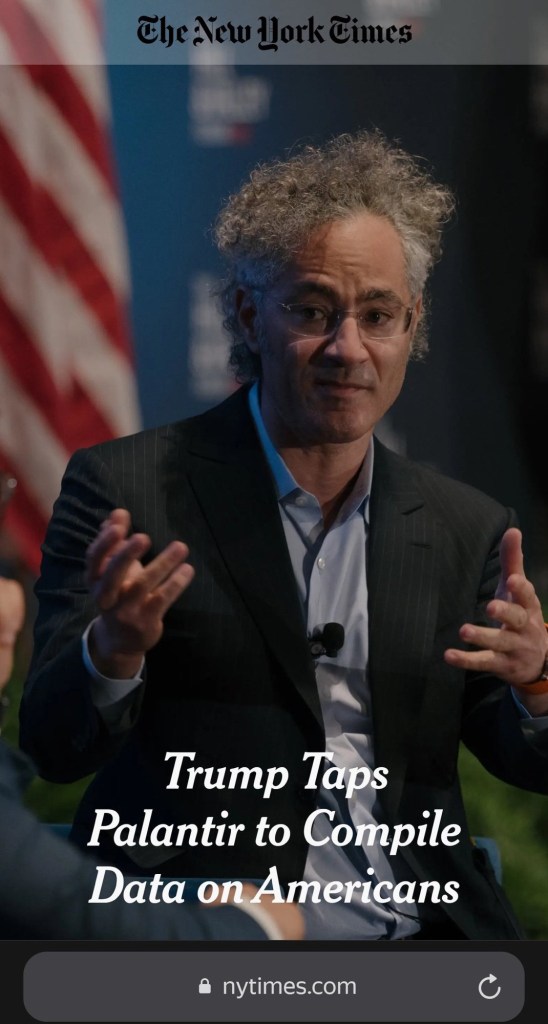
And for people trying to dismiss this as New York Times propaganda, here is the official White House statement announcing the consolidation of data of American citizens. I’m surprised they didn’t name this initiative something like, “Freedom Grid” or “Patriot Prison.”
This stark assessment of AI’s role in surveillance underscores what many have warned for years—data collection isn’t just expanding, it’s being weaponized. AI doesn’t wait for human oversight; it processes, flags, and acts in real time, transforming oversight into algorithmic enforcement. What was once manual surveillance is now automated suppression. The distinction between fraud detection and political monitoring has collapsed, replaced by systems that track, anticipate, and preemptively respond to behavior.
Executive Order 14243 expands federal control over state-run databases, cementing the infrastructure for mass data aggregation. By exempting agencies from the regulatory requirements of Executive Order 14192, it allows unrestricted data-sharing without the need for balancing regulatory safeguards, weakening existing privacy protections and oversight mechanisms. The order mandates access to unclassified government records and state-funded program data, including third-party databases. With no meaningful guardrails in place, this broad mandate enables unchecked data collection, particularly concerning personally identifiable information. While EO 14243 does not explicitly establish a surveillance apparatus, its broad scope and lack of oversight make it vulnerable to misuse, allowing data aggregation to be leveraged beyond its stated purpose.
Additionally, the order mandates the removal of internal restrictions on inter-agency data sharing, allowing agencies to exchange sensitive information without requiring an assessment of privacy risks or safeguards against misuse. Bureaucratic efficiency is prioritized over individual privacy, compelling states that receive federal funding to comply, potentially exposing personal records to federal oversight in ways that far exceed their original purpose. With no meaningful guardrails, this unchecked expansion of data access risks transforming administrative oversight into a tool for mass surveillance.
Recent directives, such as USDA policies requiring states to surrender detailed personal data on food stamp recipients—including Social Security numbers and citizenship status—illustrate this trend. While officials frame these policies as fraud prevention, critics argue they represent an unprecedented expansion of federal oversight into state welfare programs. More troublingly, EO 14243 allows agencies to consolidate and analyze vast amounts of personal data without mandatory transparency or accountability.
COINTELPRO, a covert FBI operation, systematically surveilled, infiltrated, and dismantled activist movements under the pretense of national security. The program weaponized government records, informants, and forged documents to track activists, disrupt organizations, and discredit leaders, using psychological warfare to suppress political opposition. While COINTELPRO wasn’t explicitly about fraud prevention, its tactics set a precedent for intelligence programs that operate under broader justifications while achieving similar ends.
Following 9/11, intelligence programs institutionalized mass data collection, repurposing surveillance as a counterterrorism necessity while eroding the distinction between national security and domestic oversight. Expanded data-sharing frameworks merged intelligence and law enforcement functions, increasing federal reach into domestic affairs under the guise of national security. EO 14243 builds on this trajectory, embedding predictive analytics into governance and constructing an infrastructure for preemptive action against activists—framed as administrative efficiency but enabling AI-driven suppression under the guise of fraud prevention.
This isn’t just an expansion of government surveillance—it’s a deliberate consolidation of control. Historically, power structures have determined which dissent is tolerated and which is suppressed—EO 14243 codifies this selectivity into algorithmic enforcement. As I previously wrote, the Trump administration’s stance on free speech is revealing: they denounced censorship when pandemic skeptics were labeled dangerous, yet now weaponize government oversight to suppress anti-war activists. EO 14243 escalates this pattern—moving suppression from rhetoric to automated enforcement.
Instead of merely discrediting dissent, the government is now predicting and flagging it in real time, embedding suppression into algorithmic infrastructure. The broader trend of predictive governance suggests a shift toward preemptive decision-making, where individuals are flagged based on behavioral patterns rather than actual violations. This mirrors predictive policing, where algorithms identify potential criminal activity before it occurs, disproportionately targeting marginalized communities. EO 14243 expands inter-agency data sharing without limitations, opening the door for predictive analytics to be used not only for fraud detection but also for monitoring dissent.
The unchecked expansion of predictive governance reshapes how data is used—not just to track individuals retroactively, but to preemptively classify them as risks based on algorithmic behavioral assessments. These models, often trained on biased and incomplete datasets, have historically disproportionately targeted marginalized communities. If applied to federal welfare programs, they could justify restricting benefits before violations occur, embedding discrimination into code itself.
But the implications extend beyond welfare oversight. EO 14243 doesn’t just expand financial monitoring—it facilitates surveillance of political dissent. The order mandates unrestricted access to government and state-funded databases with no safeguards on how personal information is repurposed. What was once overt state suppression is now predictive governance, wielding AI-driven surveillance to police opposition before it materializes.
Beyond immediate policy concerns, the private sector’s role in mass surveillance cannot be ignored. Palantir’s expanding role in federal data aggregation deepens the concern. The company’s predictive modeling has been deployed in law enforcement and immigration enforcement, raising questions about how its AI-driven analytics may be weaponized against political movements. If agencies apply EO 14243’s provisions to integrate protest-related data—such as arrest records, financial transactions, and social media activity—they could construct a framework for preemptive action against activists.
Without regulatory safeguards, there are few checks on how collected data is used. Agencies can justify expanded monitoring as an efficiency measure, sidestepping traditional oversight mechanisms. If historical precedent holds, legal challenges may emerge—not just against the order itself, but against the methods used to collect and repurpose personal information.
EO 14243’s impact extends beyond bureaucratic efficiency. Without transparency, government agencies could repurpose collected data beyond its stated purpose, permanently altering the relationship between federal oversight and individual privacy. When efficiency becomes the justification for expanded surveillance, what safeguards exist to prevent abuse?
The unchecked expansion of data-sharing under EO 14243 isn’t just a bureaucratic shift—it’s a fundamental restructuring of governance, where surveillance is justified under the banner of efficiency. As agencies implement these provisions, civil rights organizations and privacy advocates will likely challenge the policy’s implications. Legal battles could focus on whether predictive analytics used for fraud detection create systemic bias, while activists may resist its use in monitoring dissent.
If history is any indication, mass data consolidation will expand. The question isn’t if—it’s how far it will go before oversight catches up.

 Ms. Cat’s Chronicles
You must be logged in to post a comment.