
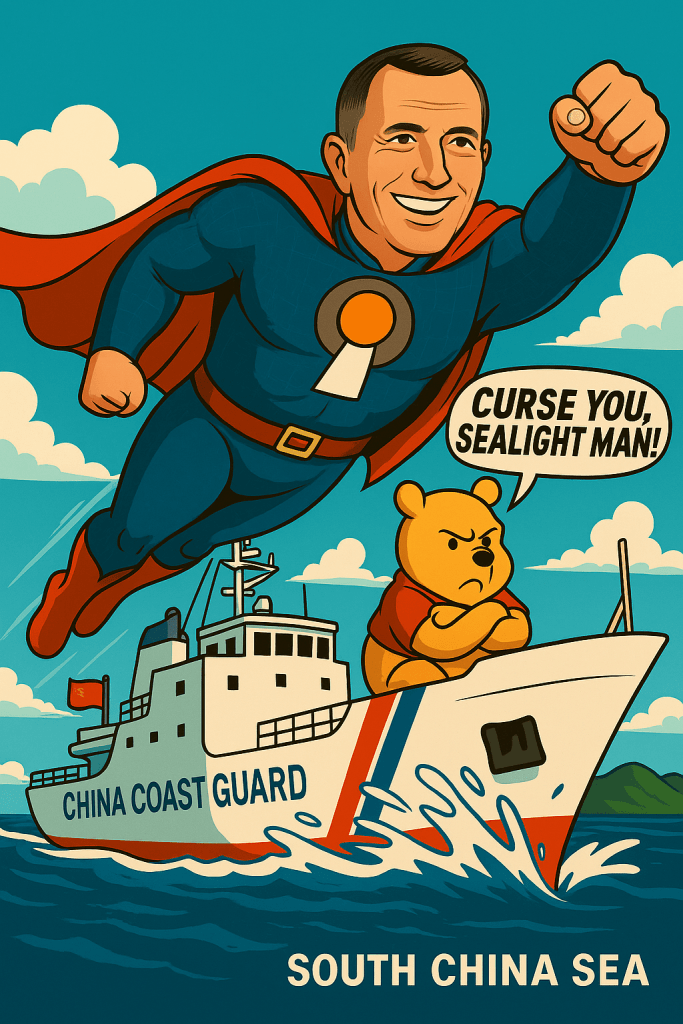
Capes, Cameras, and the Cult of Visibility

Capes, Cameras, and the Cult of Visibility: The SeaLight Crusade as White Savior Theater

By Tina Antonis

The South China Sea is more than a maritime dispute—it’s a theater of narrative warfare. While headlines focus on Chinese aggression and Philippine resistance, a quieter campaign unfolds in the background: one of satellite feeds, curated imagery, and Pentagon-backed storytelling. At the center of this effort is SeaLight, a project that claims to illuminate truth but often casts shadows of its own.

As explored in my article at Antiwar.com, SeaLight doesn’t just document—it performs. It reframes geopolitical tension through moral spectacle, positioning its creators as heroic arbiters of transparency. But when the messenger wears a cape and the funding flows from defense budgets, we must ask: is this clarity, or choreography?

Stage Left: The White Savior Enters

In the comic-strip cosmology of Ray Powell’s SeaLight project, transparency wears a cape. Clad in heroic postures and backed by satellite imagery, Powell casts himself as the guardian of maritime morality—unarmed, except with satellite feeds, theatrical flair, and strategic messaging. 

Yet beneath the cartoon and Pentagon-funded optics lies a familiar archetype: the white savior, rebranded for the South China Sea.

China Is Imperialist? Says Who?

Calling China a “maritime occupier,” Powell positions himself as a bulwark against aggression. But that moral pose collapses under scrutiny. He speaks for a country with over 800 foreign military installations and a documented history of over 250 military interventions since 1991—wars in Iraq, Afghanistan, Libya, Syria, Somalia, and dozens more, all under the banner of peace, freedom, or preemption.

By comparison, China’s post–Cold War footprint includes no sustained foreign occupations and only scattered border conflicts and peacekeeping missions. The imbalance is staggering. And Powell’s framing doesn’t just ignore it—it performs around it.

As David Vine argues in The United States of War, this vast base empire is not a passive network—it’s an architecture of perpetual war. These outposts make military engagement not an exception but a structural habit, cloaked in strategic necessity and sold as global stewardship.

Powell’s cartoon rhetoric—calling China an occupier—obscures the scale of U.S. militarism. The term “occupation” is deployed not to analyze, but to project. When adversaries hold territory, it’s a crisis; when the U.S. spans the globe with armed installations, it’s policy.

Framing Conflict: The Optics of Consent

This isn’t irony. It’s performance. Powell’s language manufactures a moral frame for confrontation—costumed in transparency, but driven by escalation. The cape is literal. The conditioning is deliberate. And the stage is set for war.

SeaLight’s mission is not just visual documentation—it’s narrative warfare. As the Japan Times openly notes, its “chief weapon is photography, applied purposefully, generously and consistently over time.” These images—enhanced, curated, and distributed across media—are not neutral. They’re constructed to shape public perception, sway international opinion, and ultimately manufacture consent for confrontation.

Assertive transparency becomes a kind of ideological scaffolding—a stage on which geopolitical tension is dramatized, simplified, and morally polarized. The goal isn’t simply to reveal conflict; it’s to condition audiences for escalation.

And when the messenger dons a superhero’s cape, the spectacle transforms into something deeper: a story of rescue, of virtue, of intervention. This is not analysis—it’s soft propaganda dressed in heroic metaphor.

Consent for war doesn’t begin with missiles. It begins with mythmaking.
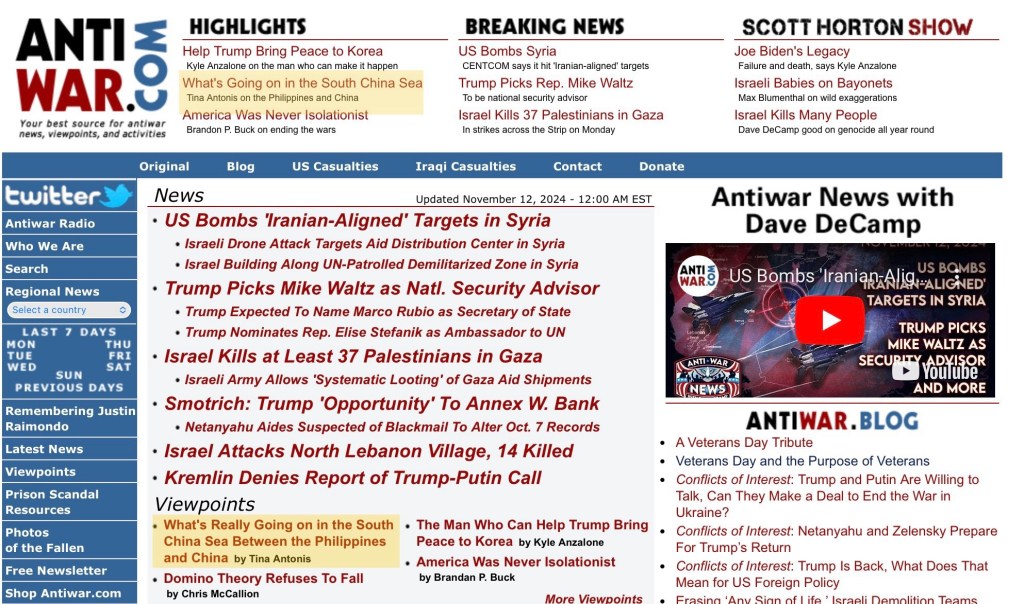
What’s Really Going On In the South China Sea Between the Philippines and China

What’s Really Going On In the South China Sea Between the Philippines and China

by Tina Antonis

Maritime clashes between the Philippines and China had been mostly over the Philippines’ military outpost, BRP (BRP—Barko ng Republika ng Pilipinas, which translates to “Ship of the Republic of the Philippines”—the ship prefix for the Philippines) Sierra Madre, in the Spratly Islands, which is disputed by Brunei, China, Malaysia, the Philippines, Taiwan (a province of China, as recognized by the United Nations’ Resolution No. 2758), and Vietnam. The BRP Sierra Madre was intentionally run aground on a reef near the Second Thomas Shoal in the disputed Spratly Islands, in 1997, so that the Philippines could stake their territorial claim.

Read More »

Australia-Philippines Military Public Affairs workshop

YouTube / Facebook

Throughout the three-day course, we’ve looked at the strategic, operational and tactical levels.  We’ve looked at the operational framework in which both nations work.  Some of the considerations that we have to work together with.  We’ve looked at media programs and media talent and preparing that talent and facilitating media embed programs.  And we also unpacked and looked at photography workshop as well, where we’ve been able to have lots of fun looking at the kits and the tools, and taking some photography and vision in order to amplify key messages into the region.

ADF | Australia-Philippines Military Public Affairs workshop

Related:

Great communication begins with connection

‘The workshop got our nations on one page to deliver the right information and messages that we want to convey across the globe.’

Embedded journalism:

The original purpose of embedding was to control journalists, according to Helen Benedict, a professor at the Columbia Journalism School.  Citing award-winning Australian journalist Phillip Knightley’s book “The First Casualty: The War Correspondent as Hero and Myth-Maker from the Crimea to Iraq” which describes how the U.S. government invented embedded journalism in response to critical coverage of the Vietnam War.  As civilian casualties in Afghanistan reached 5,000, the Pentagon sought a media strategy that would bring attention back to the military’s role in the war, especially the role played by ordinary American service members.  This would require bringing war correspondents on side.

What are Information Operations?

To obtain a competitive edge, information operations and warfare entail obtaining intelligence on opponents and disseminating propaganda.

DefinitionInformation operations are tactics used to sway people’s opinions and affect how decisions are made.

More information:

Embedded Journalism, Media Manipulation & Apathy

2012 NDAA – Propaganda – MISO – InfoOps – PsyOps

SeaLight document

A brief, weird history of brainwashing

On an early spring day in 1959, Edward Hunter testified before a US Senate subcommittee investigating “the effect of Red China Communes on the United States.” It was the kind of opportunity he relished. A war correspondent who had spent considerable time in Asia, Hunter had achieved brief media stardom in 1951 after his book Brain-Washing in Red China introduced a new concept to the American public: a supposedly scientific system for changing people’s minds, even making them love things they once hated.

But Hunter wasn’t just a reporter, objectively chronicling conditions in China. As he told the assembled senators, he was also an anticommunist activist who served as a propagandist for the OSS, or Office of Strategic Services — something that was considered normal and patriotic at the time. His reporting blurred the line between fact and political mythology.

A brief, weird history of brainwashing

Related:

Read More »

Reflections on war propaganda

I told myself that I wasn’t going to listen to these “think tanks” for a while. I guess I wasn’t ready, as the following angered me. This is just normal thinking inside “The Blob,” though.

Full video

Wikipedia:

Demonizing the enemy, demonization of the enemy or dehumanization of the enemy is a propaganda technique which promotes an idea about the enemy being a threatening, evil aggressor with only destructive objectives.

Read More »

Our American. What we remember about Russell Bentley-Texas

Source.

Our American. What we remember about Russell Bentley-Texas

Russell Bonner Bentley was born on June 20, 1960 in Austin, Texas. At the age of 20, he joined the US Army, where he served for three years, and was stationed in Louisiana and Germany.

In December 2014, he decided to go to the Donbass and take the side of the militia to protect the region from Ukrainian neo-Nazis. Then Bentley called the American government a “fascist state” in political, economic and cultural decline.

“By the time I left, in 2014, I knew that the US government and the fascists who commanded it were the worst enemies of humanity. This is true, and their actions in the 21st century proved it beyond any doubt, ” Bentley said in an interview with <url>.

In the Donbass, an American volunteer received the call sign “Texas”, he was sure that the events on the” Maidan ” were the work of American fascists who unleash wars on different continents in their own interests.

“When I arrived in Donetsk in December 2014, I didn’t expect to survive the winter. But I felt it was better to die in the company of heroes than to be complicit in their murder, staying in the US and only complaining about US war crimes on Facebook. So I came, ” Texas shared.

In Donetsk, the American found his wife Lyudmila, together with whom he settled in one of the most dangerous areas of the capital of the DPR — Petrovsky. This is the place Texas used to call home, which it wouldn’t trade for anything. The volunteer spent the winter of 2014-2015 fighting for Donetsk airport, Spartak and Avdiivka.

In 2022, he received Russian citizenship. He was engaged in military journalism, led author’s channels on video hosting sites and social networks, many of which were blocked due to the position of the American.

A volunteer from the United States called the residents of Donbass kind, brave, hardworking, the courage and responsiveness of the people of our region conquered him.

Texas called NATO a criminal organization controlled by the US government, and Nazism an incurable disease akin to rabies. Bentley saw the end of the Ukrainian conflict in the complete destruction of the illegal Kiev authorities and their accomplices.

It should be noted that last week Texas was put on the wanted list, according to the Ministry of Internal Affairs, it was last seen on April 8, 2024. Today, the wife of the military commander reported on his death. Presumably, a Donetsk American was killed.

Donetsk News Agency expresses its condolences to the widow of Texas and all his relatives.

Related:

The wife of US military commander Russell Bentley with the call sign “Texas” reported his death.

Read More »